
Percentage to Number Converter: When and How to Use It Correctly
Learn the way to convert chances into numbers correctly with step-by using-step methods, actual-life examples, and spreadsheet tips. Master reductions, scores, finances, and more the usage of a percentage to variety converter.
Rajesh Kutrapali ·
Understanding percentages and converting them into actual numbers is an vital talent for students, specialists, and every person managing statistics. From purchasing discounts and tax calculations to examination ratings and investment analysis, percentages are anywhere. A clear information helps save you errors and improves choice-making.
A Percentage to Number Converter simplifies this method, allowing accurate calculations quick. Whether you’re calculating financial growth, examination marks, or daily budgeting, these tools and techniques make sure precision.
In this guide, we can explore not simplest the way to convert possibilities to numbers however also practical applications, opposite calculations, common errors, spreadsheet strategies, and intellectual math shortcuts.
What is a Percentage and Why Does it Matter?
A percentage represents part of a whole in terms of a hundred. For example, 50% approach 50 out of a hundred, 25% manner 25 out of 100, and one hundred twenty% represents extra than the whole. Percentages assist us recognize proportions, increase, and comparisons in day by day lifestyles. A Number Converter Tool can make these calculations faster and more accurate.
Without converting probabilities to absolute numbers, it's miles difficult to make practical decisions. For instance, understanding 20% discount sounds beneficial, however understanding the precise stored quantity is crucial for budgeting.
When to use the percentage to number converter
Shopping and Discounts
One of the most common uses is to calculate the selling price during shopping. Instead of mentally guessing, a converter immediately gives the exact discount amount, making budgeting easier. Many people rely on Online Conversion tools to quickly get results without manual calculations.
financial planning
For investors and accountants, converting percentages into numbers helps determine returns, taxes, commissions, and more. For example, knowing the real value of 5% interest on the principal amount is important for effective financial management.
Academic and exam preparation
Students use conversion techniques to solve math problems, analyze data, and understand grade breakdowns. For instance, when calculating 41 out of 50 letter grade, converting percentages into actual numbers clarifies the results. It reinforces understanding beyond memorization by showing the actual numerical effects of percentages..
Business and Project Management
Managers use these conversions for budgeting, forecasting, and performance analysis. Knowing the numerical equivalent of percent completion or cost overrun helps in decision making.
Benefits of Using a Percentage to Number Converter
Accuracy and Speed
Manual calculations with possibilities may be errors-inclined. The converter reduces mistakes by automating conversion, making it in particular useful for large datasets or economic reviews.
Simplifies Decision Making
By converting abstract percentages into concrete numbers, users get clearer insights, assisting them make informed financial, academic, or commercial enterprise choices.
Accessibility and Ease of Use
Most converters are person-friendly, requiring minimum technical skills. Students, specialists, and even casual customers can gain with just a few inputs.
How to Convert a Percentage to a Number: Step-by-Step
The process involves two simple steps: converting the percentage to a decimal and then multiplying by the base value.
Step 1: Convert Percentage to Decimal
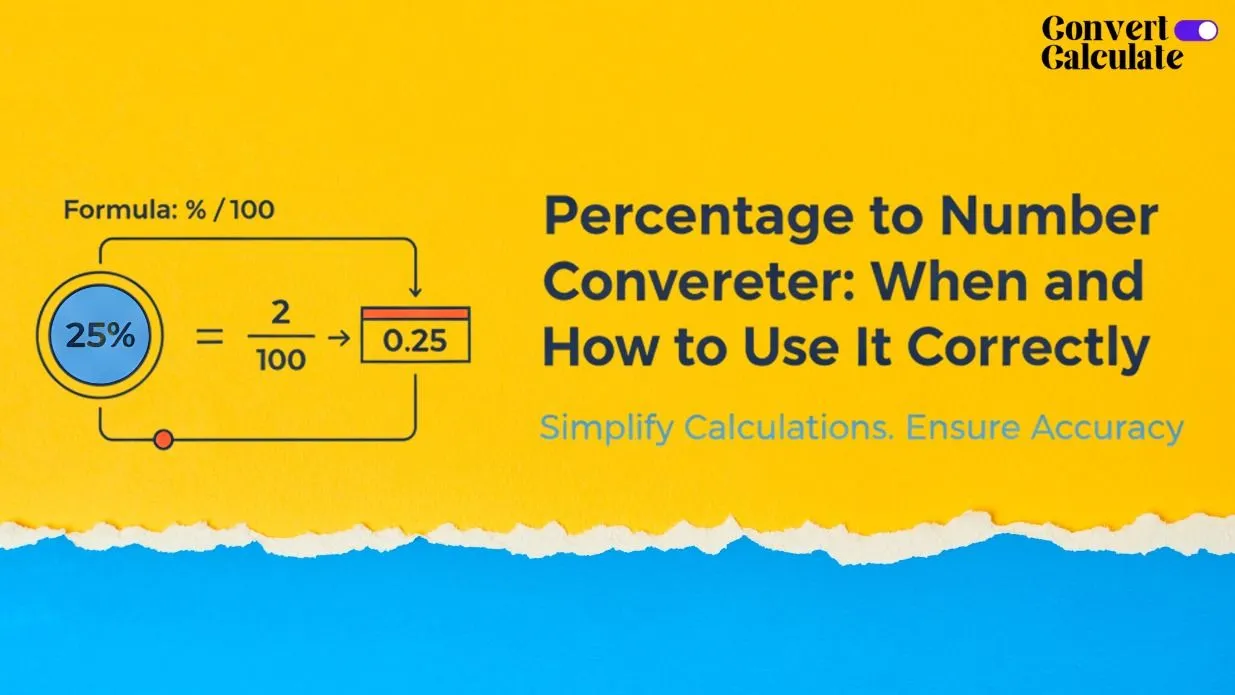
To convert a percentage to a decimal, divide it by 100. For example:
25% ÷ 100 = 0.25
175% ÷ 100 = 1.75
Step 2: Multiply by the Base Value
After converting to a decimal, multiply it by the total or base value to find the actual number. Example:
25% of 200 = 0.25 × 200 = 50
175% of 80 = 1.75 × 80 = 140
Practical Examples of Percentage to Number Conversion
Example 1: Shopping Discounts
A jacket costs $120 with a 15% discount. To calculate the discount amount:
Decimal = 15 ÷ 100 = 0.15
Discount = 0.15 × 120 = $18
Final Price = 120 − 18 = $102
Example 2: Exam Scores
If a student scored 18 out of 24, what is 40% of the total?
Decimal = 40 ÷ 100 = 0.4
Score = 0.4 × 24 = 9 points
Example 3: Investment Growth
You invest $5,000 with a 12% growth rate. Calculate growth:
Decimal = 12 ÷ 100 = 0.12
Growth = 0.12 × 5,000 = $600
Total investment = 5,000 + 600 = $5,600
Example 4: Salary Hike
If your salary is $50,000 and you receive a 7.5% increment:
Decimal = 7.5 ÷ 100 = 0.075
Increment = 50,000 × 0.075 = $3,750
New Salary = 50,000 + 3,750 = $53,750
Reverse Calculation: Finding the Base Value
Sometimes you know the part but need to determine the total. Use the formula:
Base Value = Number ÷ (Percentage ÷ 100)
Example: If $30 represents 15%, find the total:
Decimal = 15 ÷ 100 = 0.15
Base Value = 30 ÷ 0.15 = 200
Common Mistakes to Avoid
- Using the percentage directly without converting to decimal
- Confusing percentage points with percent change
- Rounding numbers too early, which reduces accuracy
- Applying the wrong base value in calculations
- Ignoring compound percentages when calculating multiple growth periods
Mental Math Shortcuts
Quick tricks help calculate percentages without a calculator:
- 10% of a number: divide by 10
- 5% of a number: divide 10% by 2
- 25% of a number: divide by 4
- 50% of a number: divide by 2
- Over 100%: multiply by 1 + decimal (e.g., 140% of 200 = 1.4 × 200 = 280)
Using Online Percentage to Number Converters
Online tools are convenient for quick calculations. They provide instant results, handle decimals, and allow batch calculations. Beginners can also learn the process step by step while using the tool.
Converting Percentages in Excel or Google Sheets
Spreadsheets are ideal for multiple calculations. Use formulas like:
- =PercentageCell/100 * BaseCell
- If formatted as %, directly multiply: =BaseCell*PercentageCell
- Use ROUND function to control decimal points
- Apply formulas across rows to calculate multiple percentages at once
Advanced Percentage Applications
Compound Percentages
Repeated percentage growth is multiplicative, not additive. For example, 10% growth on $1,000 over two years:
Year 1: 1,000 × 1.10 = 1,100
Year 2: 1,100 × 1.10 = 1,210
Total growth = 21%, not 20%
Percentage Change
To calculate increase or decrease:
Percentage Change = (New Value − Old Value) ÷ Old Value × 100
Example: $80 → $92: ((92 − 80)/80) × 100 = 15%
Reference Table: Quick Formula Guide
| Task | Formula | Example |
|---|---|---|
| Percentage → Decimal | Percentage ÷ 100 | 25% → 0.25 |
| Percentage of a number | (Percentage ÷ 100) × Base | 25% of 200 → 50 |
| Find Base | Number ÷ (Percentage ÷ 100) | 30 is 15% → 200 |
| Percent Change | (New−Old)/Old × 100 | 80 → 92 → 15% |
Practical Use Cases
- Shopping & Discounts: Calculate exact discount and final price
- Academics: Convert grades into percentages and points
- Finance: Calculate interest, tax, or investment growth
- Nutrition: Determine nutrient amounts from percentages on food labels
- Business Reports:Analyze sales growth, profit margins, or employee performance
Tips to Master Percentage Calculations
- Double-check the base value
- Use mental shortcuts for small calculations
- Use converters or spreadsheets for large numbers
- Avoid early rounding
- Practice with real-life examples to build confidence
Conclusion
- Double-check the base value
- Use mental shortcuts for small calculations
- Use converters or spreadsheets for large numbers
- Avoid early rounding
- Practice with real-life examples to build confidence
Conclusion
Mastering percentage to number conversion improves accuracy in academics, finance, business, and daily life. Use formulas, mental math tricks, converters, and spreadsheets to simplify calculations.
Remember:
- Convert percentage to decimal first
- Multiply by the base value
- Double-check results for accuracy
- Use tools or spreadsheets for efficiency
Applying these techniques consistently ensures confidence and precision in handling percentages across all scenarios.
Frequently asked questions
What is a Percentage to Number Converter, and why is it useful?
A Percentage to Number Converter is a tool that quickly converts percentages into their actual numeric values based on a given total. It is useful for students, professionals, and anyone working with financial, academic, or business calculations, saving time and reducing errors.
How do I use a Percentage to Number Converter effectively?
Simply enter the percentage and the total value you want to apply it to. The converter calculates the exact number automatically. For example, 25% of 200 becomes 50. Always double-check the total to ensure accurate results.
Can a Percentage to Number Converter handle decimal percentages?
Yes. Modern converters handle decimal and fractional percentages accurately. For example, converting 12.5% of 480 gives 60, making it ideal for finance, statistics, and scientific calculations.
When should I use a Percentage to Number Converter instead of manual calculation?
Use a converter when dealing with large numbers, frequent calculations, or when accuracy is crucial. It eliminates manual errors and speeds up calculations for exams, reports, budgeting, and data analysis tasks.
Is it necessary to know how to calculate percentages manually if I use a converter?
While a converter simplifies calculations, knowing the manual method is important for learning, verifying results, and handling situations without a tool. Manual knowledge ensures you interpret results effectively.
Can a Percentage to Number Converter be used in business and finance?
Absolutely. Businesses use it to calculate discounts, taxes, commissions, or profit margins quickly. Financial analysts also rely on it for data conversion and reporting, making it a practical tool for everyday business operations.
Are online Percentage to Number Converters free and easy to use?
Yes. Most online converters are free, intuitive, and require no installation. They provide instant results and are accessible on both desktop and mobile devices for convenience anywhere, anytime.
How does using a Percentage to Number Converter reduce calculation mistakes?
By automating the conversion, the tool eliminates human errors from manual calculations. It ensures accurate results every time, which is especially useful when working with large datasets, multiple percentages, or financial data.